Optimum OP-ECOSAVE Immersion Timer: A practical, no‑frills solution for Economy‑style hot‑water control
July 29, 2026The Optimum OP‑ECOSAVE is a deliberately simple mechanical timer for immersion heaters on Economy‑style tariffs. It uses a 24‑hour quartz dial with 15‑minute tappets, an adjustable short‑term boost and a manual override, and it’s intended for surface‑mounted, electrician‑fitted installations where owners want dependable scheduled control without smart features or remote access.
Is this the right type of timer for your cylinder?
Think of the OP‑ECOSAVE as a straightforward timing device rather than a modern home‑automation hub. It is best suited to households that:
- Have an Economy‑style supply (two‑tariff) and want the immersion to run during the cheaper off‑peak window.
- Prefer a physical dial and visible indicator lights so the status of the timer is obvious at a glance.
- Require a simple daytime boost option for extra hot water without reprogramming the clock.
- Will have the unit installed by a qualified electrician into a dry room (IP20), typically in a cupboard or utility room near the cylinder.
It is not the right choice if you need any of the following:
- Remote control, app access or tariff‑auto switching from your supplier.
- Complex weekly schedules or different timings for weekends and weekdays — the OP‑ECOSAVE offers only a 24‑hour mechanical programming method.
- An all‑in‑one control that replaces a thermostat: this timer only switches power to the elements, so temperature control remains the job of the cylinder thermostat(s).
How it will behave in a real household
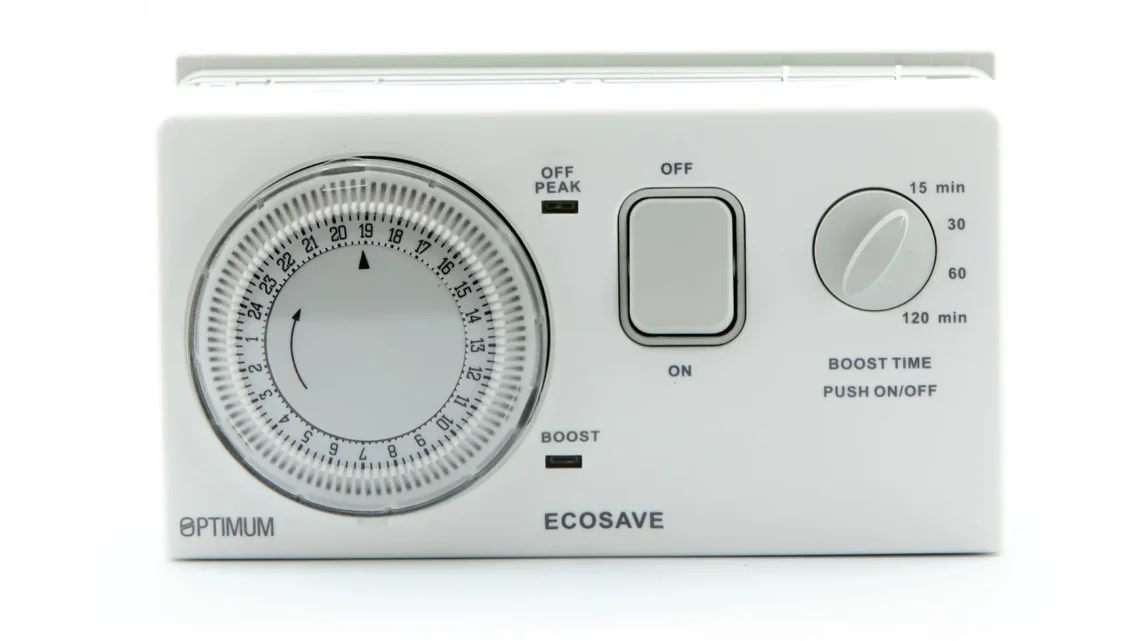
At its core the OP‑ECOSAVE simply supplies or cuts power to the immersion element(s) according to the tappets you set around the dial. In a typical Economy‑7 scenario you would lift the tappets for the off‑peak hours on each 24‑hour dial and the timer energises the immersion during those windows. The boost button gives you a one‑off daytime run of 15, 30, 60 or 120 minutes, selectable depending on how much extra hot water you need occasionally.
Practical ownership examples:
- Small household on Economy‑style tariff: set the off‑peak window once and let the timer handle hot‑water charging automatically; use the boost for an occasional evening bath.
- House with twin elements or dual‑element cylinders: the unit is specified for single, dual or twin immersion configurations and is intended to switch typical 3kW elements, so it fits common domestic arrangements. Note that the timer is a switching device only — any element protection or thermostatic control must remain in place.
- Flat or rented property where landlords want a low‑complexity, visible control: the mechanical dial and indicator lamps make the state of the timer clear to tenants without a learning curve.
Installation and compatibility — what the electrician needs to know
The OP‑ECOSAVE is surface‑mounted and supplied with a separate wiring base. It is designed for fixed wiring rather than a plug‑in arrangement, so installation should be carried out by someone competent and authorised to work on mains circuits — in practice that means an electrician. The manufacturer’s instructions indicate terminal wiring and recommend using the supplied cable clamp and ferrules for stranded conductors.
Key technical compatibility points for installers and buyers:
- Supply: 220–240V AC, 50Hz, so it matches standard UK domestic voltage.
- Contact/load rating: 16A resistive (2A inductive). At 230V this broadly aligns with standard 3kW immersion elements, which are the intended load. For higher‑current or unusual elements, a suitably rated contactor or relay should be used instead of relying on the timer’s internal contacts alone.
- Running reserve: roughly 72 hours, so clock settings are retained during short outages; that helps avoid reprogramming after brief power cuts.
- Mounting environment: IP20 — dry rooms only. It must not be mounted in bathrooms, outdoors or any damp space, and care should be taken about proximity to motors or transformers that create inductive discharges.
Remember: the timer switches mains power. You still need the cylinder thermostat(s) in place to prevent overheating, and RCD/MCB protection and correct wiring practices must be followed to comply with current regulations.
Performance and operational behaviour
Performance in this context is about reliable switching and predictable behaviour. The OP‑ECOSAVE uses a quartz 24‑hour clock, tappets adjustable in 15‑minute increments, and separate indicator lamps showing timed and boost outputs. These are practical design choices for users who want to see at a glance whether the immersion is being powered by the scheduled on‑period or by a manual boost.
Because it’s mechanical, you won’t get the flexibility of multi‑day schedules, nor will the timer react to supplier signals to change tariff periods or respond to remote load‑management instructions. For many homeowners this is acceptable: the simplicity reduces the chance of configuration errors and avoids software or connectivity failures. The downside is that any modifications to the off‑peak times — for example, a supplier‑driven change to off‑peak hours — must be adjusted manually at the unit.
Strengths, compromises and realistic limitations
Strengths:
- Simplicity and clarity: the physical dial, tappets and indicator lamps are easy to understand without reading an app or manual every time.
- Boost flexibility: selectable boost durations (15, 30, 60 or 120 minutes) make it simple to add a short daytime heating period when required.
- Appropriate electrical rating for standard domestic immersions: designed around 3kW elements with a 16A contact rating makes the product suitable for the common use case.
- 72‑hour running reserve: avoids losing the clock setting in the event of short interruptions to power.
Compromises and limitations:
- No smart features: no Wi‑Fi, no remote control, and no automatic tariff switching from the supplier. This excludes users who want app control or energy‑management integrations.
- Single 24‑hour scheduling method: you programme the daily pattern with tappets, which is fine for daily repeat schedules but not if you need different timings on different days of the week.
- IP20 restriction: surface‑mounting in dry rooms only, which limits siting options and makes it unsuitable where an IP-rated enclosure is required.
- Contact rating suitable for resistive loads: if your installation includes inductive loads or unusual element configurations, further protective or switching hardware may be necessary.
Maintenance and long‑term ownership
Because the OP‑ECOSAVE is a mechanical and electrical device with a quartz clock, long‑term considerations are straightforward. There are no batteries to replace for timekeeping — the running reserve is internal — and there are no software updates to manage. Routine ownership tasks include:
- Checking the tappet settings periodically, particularly if your tariff or household routine changes.
- Using the manual override and boost only as designed and ensuring the cylinder thermostat is functioning correctly to prevent overheating.
- Inspecting the installation periodically for cable condition and secure mounting; because the unit is mounted on a wall and hardwired, cable clamps and terminals should be checked when carrying out other maintenance.
From a support perspective, buyers should expect standard manufacturer guidance and an installation leaflet. As with any mains device, return or warranty procedures will typically require evidence of correct installation and may specify that installation was performed by a qualified electrician.
Value and buying considerations
Value here depends on what you need the timer to do. If you want a rugged, low‑complexity device that reliably energises immersion elements during off‑peak hours and provides a selectable short boost, the OP‑ECOSAVE represents a clear functional proposition: you get visible controls and simple mechanical programming without the complications of connectivity or app ecosystems.
Things to weigh before purchasing:
- Installation cost: the device is intended for electrician installation. Factor in fitting and any required additional wiring or protective components if you don’t already have a suitable switched circuit near the cylinder.
- System compatibility: confirm the element size and circuit protection match the timer’s contact rating. For non‑standard elements or combined loads, a contractor may advise installing an intermediate contactor or a different timer with higher switching capacity.
- Future proofing: if you anticipate wanting remote control, supplier‑driven tariff switching or integration into a smart home, a digital or smart timer may be a better long‑term choice despite higher initial cost and greater complexity.
Practical checklist before you buy or install
- Confirm your tariff type (single vs multi‑tariff). The OP‑ECOSAVE is designed for Economy‑style supplies.
- Check immersion element ratings against the timer’s 16A resistive contact rating; consult an electrician if in doubt.
- Decide on siting: the timer must be surface‑mounted in a dry location (IP20). Identify a dry cupboard or utility wall near the cylinder.
- Plan for cylinder thermostats to remain in place — the timer does not replace temperature control devices.
- Budget for electrician labour and potential extra components such as a contactor if your installation requires higher switching capacity.
Conclusion — who should choose the OP‑ECOSAVE?
The OP‑ECOSAVE is a pragmatic pick for households that value reliability, low complexity and clear physical controls. It is particularly appropriate where an electrician will install a permanent surface‑mount timer to run immersion elements during familiar off‑peak windows, and where occasional manual boosts are useful. It is not aimed at users who want smart features, flexible day‑by‑day programming or remote control — for those needs a digital or connected alternative would be more suitable.
In short: if your priority is dependable, electrician‑installed timed control for standard domestic immersions on an Economy‑style tariff, and you accept the limits of a mechanical 24‑hour clock, the OP‑ECOSAVE offers a straightforward, maintainable solution. If your priorities include app control, tariff auto‑switching or advanced schedules, look to more feature‑rich digital timers instead.
Latest product offer
Ready to check OP-ECOSAVE Immersion Heater & Economy 7 Timer?
Check the latest product page, price and offer details before buying.