OP‑IHTGPT 24‑Hour Immersion Timer — a pragmatic, no‑frills daily scheduler
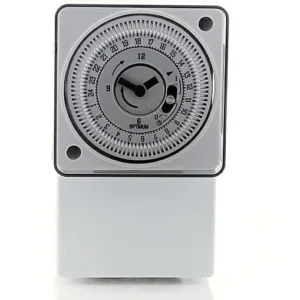
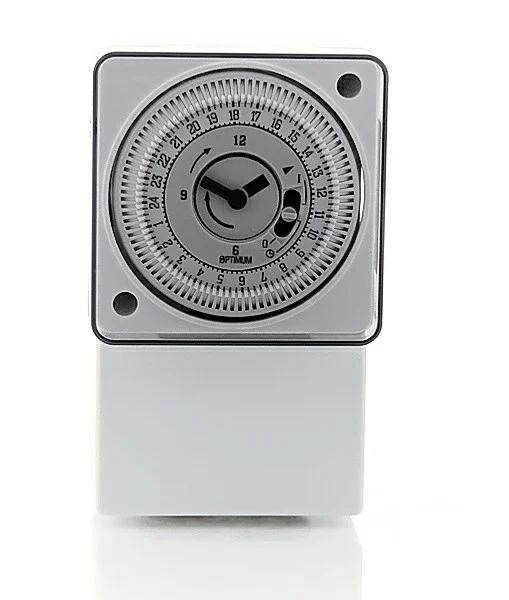
July 29, 2026The OP‑IHTGPT is a classic mechanical 24‑hour timer: a small, surface‑mounted unit with a synchronous dial, captive tappets for ON/OFF programming and an SPDT changeover contact that can be used either as a mains switch or as a volt‑free control. It doesn’t pretend to be a smart controller — there’s no remote access, no power‑use metering and no multi‑day programming. What it does offer is simple, inexpensive and widely understood behaviour that suits conventional hot‑water setups and other basic time‑based switching tasks.
Where this timer fits in a heating system
This timer is primarily intended for daily scheduling: think heating a domestic hot‑water cylinder once or twice each day, or turning small resistive or inductive loads on and off on a repeatable daily pattern. Because the internal motor is mains‑synchronised and the dial represents a single 24‑hour cycle divided into 15‑minute tappets, it’s most appropriate where you want fixed daily windows rather than variable weekly schedules or thermostat‑style control.
Two practical uses stand out: direct switching of immersion heaters that fall well within the timer’s resistive rating, or acting as a control signal to a contactor that switches larger loads. The unit’s removable brass link makes it flexible: leave the link in to use it as a mains‑switching timer, or remove the link to provide volt‑free contacts for a contractor or external control circuit.
Who should consider the OP‑IHTGPT — and who should look elsewhere
Suitability:
- Households with a straightforward hot‑water schedule and no need for remote control or complex programming.
- Installers wanting a low‑cost, reliable daily scheduler for immersion heaters or other resistive loads up to the unit’s rating.
- Situations where a volt‑free contact is required to drive a contactor or integrate into existing control wiring.
When to avoid it:
- If you need high precision timing, frequent short cycles or timing resolution below 15 minutes — this unit’s minimum interval is 15 minutes.
- If you plan to switch LED drivers, electronic ballasts, HID or other discharge lighting directly — the manufacturer explicitly warns these loads aren’t suitable without a contactor because of inrush currents and driver electronics.
- If you require weatherproofing or outdoor mounting — the timer is IP20 and Class II, so it’s for dry indoor locations only.
- If you want flexible weekly programmes, remote control from a phone, or integration with smart home systems — this is a mechanical device without those capabilities.
Installation and wiring — practical considerations
The OP‑IHTGPT is surface‑mounted and designed for installation on a dry, non‑metallic surface. It has five screw terminals plus an earth park, with cable clamps provided for neat strain relief. The unit is Class II, so double insulated; the earth park is present for convenience where wiring practices or local regulations require an earth take‑off.
Key wiring notes to bear in mind:
- The timer is supplied for 220–240 V AC, 50 Hz operation. Its internal motor is mains‑synchronised so the dial keeps time relative to mains frequency.
- By default the timer has a removable brass link which configures the SPDT contact for mains switching. Removing that link converts the contact to volt‑free operation — essential when you intend to drive a separate contactor or relay rather than load the timer directly.
- Observe the rated currents: 16 A resistive and 8 A inductive (cos φ 0.6). For immersion heaters around 3–3.5 kW, it’s advisable to use the timer to operate a suitably rated contactor rather than switching heavy loads directly near the timer’s limits. This reduces contact wear and improves long‑term reliability.
- The minimum switching load is specified as 100 mA at 20 V AC/DC — be sure the controlled circuit meets this if the timer is used for low‑current signalling.
- Installation must comply with current IEE wiring regulations. If you are not a qualified electrician, get a professional to wire and commission the unit.
Programming and everyday use
Programming is deliberately simple: set the current time by rotating the dial clockwise to align the hour marker, then press the captive 15‑minute tappets in or out to define ON and OFF periods. The captive tappets mean you won’t lose parts during setup, and the dial is designed to be rotated only clockwise — rotating anti‑clockwise risks damaging the mechanism.
A three‑position manual selector provides Fix ON, Timed (AUTO) and Fix OFF modes. The selector is mechanical and remains where you set it, so it’s a straightforward way to override scheduling for maintenance or special circumstances.
Because the mechanism is mains‑synchronised, typical accuracy is in the order of a few seconds per day — enough for daily hot‑water timing but not for tasks that require minute‑precise control or complex staggered events.
Performance in realistic ownership scenarios
Reliability and predictability are the timer’s strong points. Mechanical synchronous timers like this have been used for decades to provide repeatable daily switching. Expect predictable behaviour provided the supply frequency remains steady and the unit is installed in a suitable environment (dry, within operating temperature range).
That said, there are practical limits to what a device of this type can handle:
- Switching heavy resistive loads near 16 A continuously will stress the internal contacts; repeated switching under load is what wears mechanical contacts. Using the timer as a control device for a contactor extends its life.
- The 15‑minute minimum interval means the timer is not suitable for applications that need rapid cycling or short bursts of power — for example, load‑shedding strategies that require finer resolution or staggered cycles.
- The IP20 rating rules out wet or outdoor locations; condensation or exposure to dust can impair the mechanism and contacts.
Compatibility nuances
Two compatibility aspects deserve attention:
- Load type: resistive loads such as immersion elements are straightforward if within the rating. Inductive loads (motors, pumps) impose additional stress and the timer’s inductive rating is lower — 8 A at cos φ 0.6 — so always check the motor’s starting current and consider a contactor if in doubt.
- Electronic loads: LED fittings, modern boiler controls and any equipment with electronic drivers or sensitive control inputs may not behave well when switched directly by the timer. The manufacturer specifically warns against switching HID, SON, discharge or LED lighting without a contactor. If you need to control such devices, use the timer to drive a relay or contactor sized for the load, or choose a controller rated for electronic loads.
Maintenance and expected service life
There are no serviceable electronics inside beyond the mechanical motor and contacts. Maintenance is therefore limited to sensible precautions:
- Keep the unit in a dry, dust‑free environment and avoid mounting near sources of condensation.
- If the timer is used to switch near its rated current regularly, consider periodic inspection of contacts by a qualified electrician. Contact wear is the common failure mode in mechanical timers.
- For long life, use the timer to control a contactor when switching loads that approach or exceed the timer’s inductive rating.
- Because the mechanism is mains‑synchronised, significant mains frequency variations are outside the timer’s control and could affect long‑term timing precision — although typical domestic supplies are stable enough for daily hot‑water scheduling.
Spare parts aren’t generally a user‑replaceable option for small mechanical timers; where reliability is critical, budget for replacement at end of life rather than expecting to repair the mechanism in situ.
Value and buying considerations
Value depends on what you need. If all you require is dependable, low‑cost daily switching without bells and whistles, a mechanical timer of this kind represents sensible value: simple to understand, easy to programme and offering the flexibility of volt‑free or mains switching. For installers replacing worn‑out mechanical timers or fitting a basic immersion controller, the OP‑IHTGPT is a pragmatic choice.
However, if you want weekly programming, remote access, energy monitoring, precise timers for load management or the ability to directly switch modern electronic loads, a mechanical dial timer will feel limited. Consider these points before buying:
- Match the timer’s current ratings to the load and allow margin. If the load approaches the 16 A resistive or 8 A inductive ratings, plan to use a contactor.
- Decide whether the lack of a weekly calendar or remote override matters. Many households now prefer smart controllers for tariff‑based scheduling and out‑of‑home control; this unit cannot provide that functionality.
- Think about environmental conditions and mounting location because IP20 restricts where the unit can be placed.
Limitations to be realistic about
Summarising the important compromises:
- Coarse programming resolution — 15‑minute steps only.
- No weekly calendar or multi‑day programming; the pattern repeats every 24 hours.
- No remote control, telemetry, or smart integration.
- Not suitable for direct switching of LED or discharge lighting, or heavy inductive loads without a contactor.
- IP20 means indoor, dry locations only.
Typical buyer scenarios
Scenario A — small house with single immersion heater and off‑peak tariff: A homeowner who wants the cylinder heated once a day to coincide with an off‑peak period, with simple mechanical override for holidays, will find the OP‑IHTGPT straightforward and cost‑effective. Wired via a contactor it will control a typical 3 kW immersion element reliably.
Scenario B — landlord managing tenanted properties: For multiple properties where simplicity and durability are priorities and sophisticated schedules are unnecessary, a mechanical timer keeps things simple for tenants and maintenance staff. The lack of smart features can be a benefit here, reducing accidental misconfiguration.
Scenario C — modern retrofit with smart controls and LED lighting: If the project needs integration with smart meters, tariff switching across unusual windows, or direct control of LED drivers and boilers, this timer won’t meet those expectations and a digital or smart controller should be chosen instead.
Summary judgement
The OP‑IHTGPT is a competent, no‑nonsense mechanical 24‑hour timer for basic daily scheduling of immersion heaters and other compatible resistive or inductive loads. Its strengths are simplicity, low cost, and the flexibility afforded by a removable link that enables either mains switching or volt‑free control. For homeowners and installers needing a straightforward daily scheduler — particularly when used to drive a contactor for heavier loads — it represents a pragmatic choice.
On the flip side, it’s not a good fit when you need fine timing resolution, weatherproofing, smart features, weekly programming or direct switching of modern electronic lighting. If you require any of those capabilities, a digital or specialist controller is the better route.
In short: choose the OP‑IHTGPT when you want a reliable, familiar mechanical timer for indoor, repeatable daily control and are prepared to use a contactor where load or load type demands it. Look elsewhere if your needs extend beyond that simple, repeatable daily schedule.
Latest product offer
Ready to check OP-IHTGPT 24 hour Immersion Timer?
Check the latest product page, price and offer details before buying.