
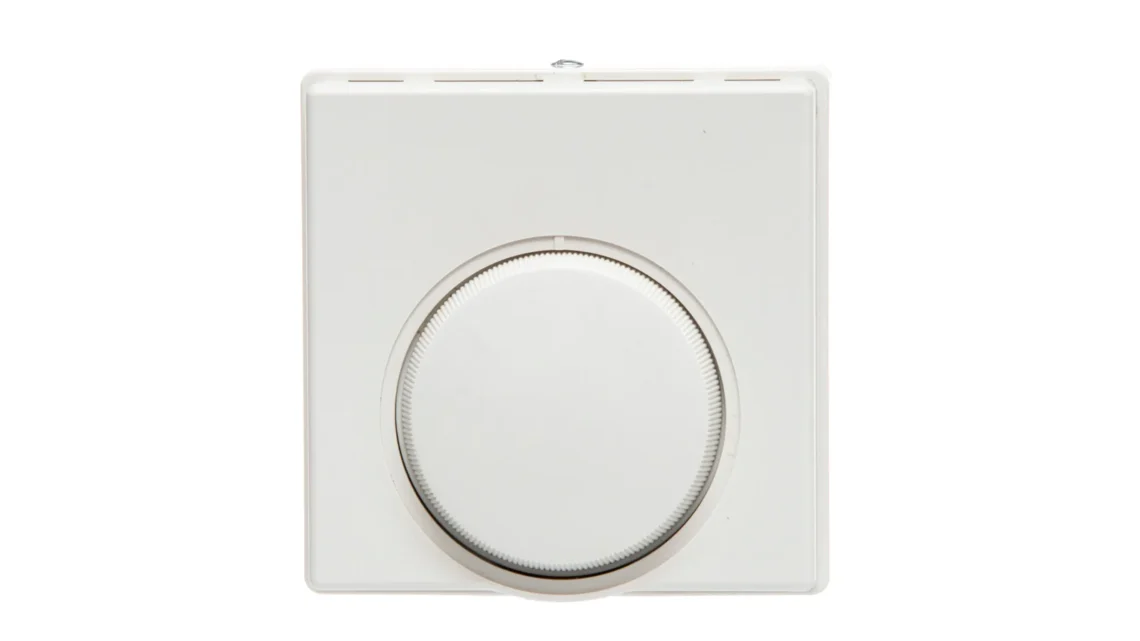
Tower STTPRS Tamper‑Proof Thermostat — a pragmatic choice for simple, secure room control
July 29, 2026The Tower STTPRS is a basic mechanical room thermostat built around a sealed bellows sensor and a manual dial concealed behind a blank cover. It’s intended for situations where unauthorised changes must be prevented and where a single, manually set temperature is sufficient. The unit’s strengths are its simplicity, compactness and clear installation approach; its limitations follow directly from that simplicity — no display, no scheduling, no connectivity and a straightforward switching contact that requires careful matching with the heating system it controls.
Where this thermostat makes sense
Think of the STTPRS as a utility control rather than a living‑room gadget. It suits environments such as rental properties, communal corridors and rooms, student accommodation, schools and basic commercial spaces where:
- you want to lock the setpoint so tenants, pupils or visitors cannot change it easily;
- there is no need for daily programming, temperature logging or remote adjustments;
- you prefer a low‑cost, low‑maintenance mechanical device over an electronic or smart thermostat.
For caretakers, facilities managers and landlords the appeal is obvious: set the temperature, secure the cover and reduce calls about accidental or deliberate setpoint tampering.
Who should avoid this model
If you expect to control heating by time schedules, remotely via an app, or as part of a smart home or BMS (building management system), this is not the right product. Similarly, households that want to run different temperatures at different times of day, or owners who rely on temperature readouts to check room conditions, will find the STTPRS too limited. Also avoid it where a volt‑free (potential‑free) switching arrangement is mandatory for your boiler or controller unless an installer confirms the internal wiring will suit that requirement.
How it operates in everyday use
Operation is intentionally simple. The sealed bellows expands or contracts with room temperature, moving the internal mechanism until the switching contact opens or closes at the chosen setpoint. The visible features are minimal: a neutral white housing about 85 × 85 × 40 mm and a blank cover that prevents casual dial access.
The unit provides single‑setpoint control between 10°C and 30°C, with a 1°C differential. That differential is typical of mechanical thermostats and keeps the room temperature within a reasonable band around the setpoint, but you should expect normal on/off cycling. The thermostat does not display the measured temperature, and there’s no hysteresis tuning or adaptive control — it is what it is: a mechanical thermostat doing the basic job of calling for heat when the room is below the setpoint and stopping it when the upper threshold is reached.
Electrical and compatibility considerations
The STTPRS has a contact rating of 10(3) A, which covers most domestic boiler and actuator loads commonly used with a room thermostat. The product notes describe the thermostat as suitable for mains or low‑voltage systems and explicitly list compatibility with combi boilers. That makes it a practical replacement for many basic room thermostats.
However, a few important caveats matter in practice:
- Some modern boilers and heating controllers require a volt‑free contact to register a call for heat; others expect a live feed to be switched. The STTPRS’s switching arrangement must match what your boiler expects. Before fitting, ask your installer or check the boiler manual and confirm whether a potential‑free switch is required.
- The 10(3) A rating is a useful guideline but does not licence arbitrarily high inductive loads. If you plan to switch larger loads or certain types of control electronics, confirm compatibility with the installer or supplier.
- It’s designed for wall mounting using 60 mm fixing centres and fits standard back‑boxes. The cover includes four conduit breakouts to tidy surface runs; the wiring can be done either in‑wall or surface‑run depending on site requirements.
Installation and practical setup
Installation is straightforward for a competent electrician or heating engineer. The thermostat’s small footprint makes it easy to position on a wall at a representative room height away from direct heat sources or draughts that could bias the sensor.
Key practical points to follow during installation:
- Mount in a location where the sensor reads the average room temperature — typically around 1.5 m above floor level and away from radiators, direct sunlight, doors, or ventilation grilles.
- Confirm the wiring arrangement required by the central heating system. If the boiler needs a volt‑free contact, either ensure the STTPRS provides it or fit an appropriate interface relay.
- Decide how the tamper cover will be secured. The unit’s cover hides the dial, but the method of securing and accessing the cover (screws or a keyed lock, for example) should be clarified before fitting so authorised users can adjust the setpoint when necessary.
- Use the conduit breakouts provided to keep surface wiring neat and protected; this is often important in communal or rented properties where appearance and durability matter.
Performance expectations and limitations
Because the STTPRS is a mechanical device with a sealed bellows sensor and a 1°C differential, performance expectations should be modest and realistic:
- Temperature control will be adequate for straightforward heating systems. Expect normal cycling rather than continuous modulation — the thermostat will turn the boiler or valve fully on or off around the setpoint.
- There is no temperature display, so you will not see the instantaneous room temperature without temporarily removing the cover to view the dial setting (and then only the setpoint, not a readout of actual temperature). If knowing the room temperature is important, fit a separate thermometer or choose a thermostat with a display.
- The lack of programmability means no automatic night‑time setback or weekday/weekend schedules. Where energy savings are sought through timed reductions, the STTPRS will not deliver them by itself.
Durability and maintenance
Mechanical thermostats with sealed bellows are inherently simple and typically require very little maintenance. There are no batteries to replace and no firmware to update. That said, a few practical maintenance notes are worth keeping in mind:
- Check the physical condition periodically — ensure the cover remains secure, the housing is intact, and wiring connections are tidy and free from corrosion.
- If the thermostat is fitted in a damp or exposed location, be cautious: the product information does not state an IP rating. Avoid installing it in bathrooms or outdoors unless the mounting location is dry and protected or you have confirmation from the supplier that the location is acceptable.
- If the system behaves oddly (frequent short cycling, persistent overheating or failure to call for heat), the usual diagnostic steps apply: confirm wiring and switching arrangements, check the boiler’s response to a known working thermostat, and if necessary have an engineer test the thermostat’s contact operation and sensor response.
Support and longer‑term ownership
The STTPRS’s longevity is linked to the simplicity of its design. With no electronics, the usual failure modes are mechanical wear or loss of contact reliability. For long‑term ownership, consider the following:
- Keep the install documentation and supplier contact details to hand in case you need wiring diagrams or replacement parts.
- Agree with your installer how authorised users will access the concealed dial (for example, if the property manager needs to change the setpoint seasonally).
- Plan for eventual replacement if you later decide you need programmable or connected control; replacing the STTPRS with an electronic unit should be straightforward provided the mounting and wiring are compatible.
Value and buying considerations
Value for this thermostat is not measured by features but by suitability. If your priority is a low‑cost thermostat that prevents unauthorised adjustment and will last with minimal care, the STTPRS offers clear value. It avoids the extra cost and management overhead of electronic controls and smart systems.
Before buying, check these points with your supplier or installer:
- Confirm the thermostat’s switching arrangement is compatible with the boiler or controller (especially whether a volt‑free contact is required).
- Ascertain how the tamper cover is fastened and how authorised access is achieved.
- If the installation site is exposed to moisture, check whether a more suitable IP‑rated enclosure or an alternative product would be better.
Balanced conclusion
The Tower STTPRS is an honest product with a narrow but well‑defined role: secure, single‑setpoint room control without electronics. It performs that role with the usual advantages of mechanical reliability and low maintenance, and it’s especially useful where preventing unauthorised adjustments matters more than convenience or automation.
It is not suitable for anyone who wants scheduling, remote control, temperature display or fine integration into advanced heating systems. Compatibility with a specific boiler’s switching requirements must be checked before fitting, and the lack of IP information means care is needed when considering damp or exposed locations.
If you need a robust, low‑cost thermostat to hold a setpoint in communal or rented spaces, and you accept the trade‑off of manual, nonprogrammable control, the STTPRS is a practical choice. If your needs include energy savings through schedules, smartphone control or detailed system integration, look instead at electronic or smart thermostats — or consider an equivalent mechanical thermostat installed inside a locked cabinet that provides similar tamper resistance with modern controller features elsewhere.
Summary: reliable, simple and inexpensive for its intended use — avoid if you need programmability, connectivity or a display.
Latest product offer
Ready to check Tamper Proof Thermostat?
Check the latest product page, price and offer details before buying.

I am preparing a small set of Suno stems for a community project, and the last export left faint clicks and metallic tails between phrases. The tracks are usable, yet those details become distracting on headphones. I do not need a dramatic remake; I want careful cleanup that preserves timing and the character of the vocals. While comparing practical options, I found this workflow note. It gave me a starting point, but I would value advice from people who have tested similar tools. I am trying to decide whether selective repair belongs before or after a light EQ pass. My immediate concern is retaining unforced vocal detail. A separate test render seems reasonable. I can compare a few sections without changing the whole track. The repair should remain reversible. Any processed layer must align cleanly with the original. I also need repeatable settings for later revisions. A focused listening session may reveal more than meters alone. The final mix should still feel direct. The chosen steps must be quick to document. I will also listen at normal volume. I would rather leave a minor flaw than create a new one. Has anyone found a dependable order for this kind of light repair? Thank you for any first-hand experience.
Thanks for sharing your detailed approach! While our content focuses on thermostats and heating controls, your careful workflow for vocal cleanup sounds well thought out. Testing selective repair before or after EQ with separate test renders is a smart way to preserve vocal character and keep changes reversible. A focused listening session, as you plan, is definitely key to balancing detail retention with minimal artifacts. If you have any questions about heating control products or installations, feel free to ask!