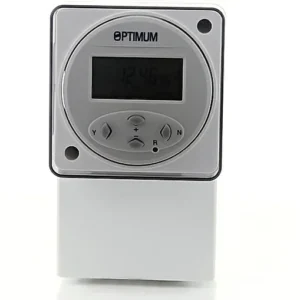
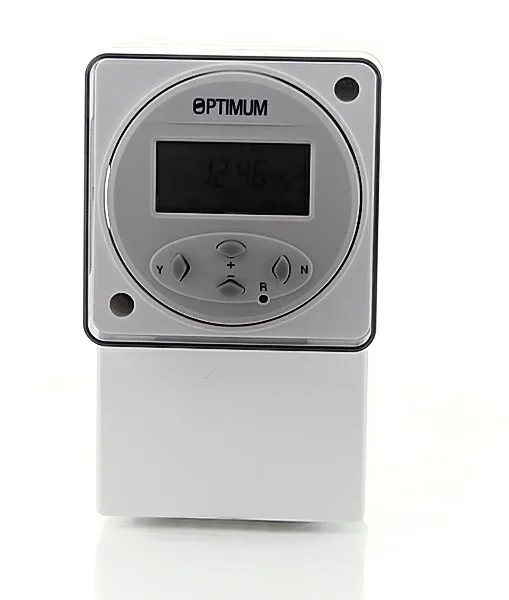
OP-IHTDIGI Digital Immersion Timeswitch — a clear, low‑cost timer for simple water‑heating control
July 29, 2026The OP‑IHTDIGI is a small, surface‑mounted digital timeswitch intended primarily for controlling immersion heaters and similar resistive loads. It provides a straightforward set of scheduling options — 24‑hour or 7‑day programming, up to 24 on/off events and a one‑minute minimum setting — plus a few manual modes such as fixed on/off, countdown and a Random option that nudges programmed times by up to 28 minutes.
Who this suits — and who should look elsewhere
This timer will appeal to anyone who needs dependable, local scheduling for a heater or other resistive appliance without the complication or privacy issues of cloud services. Typical users include landlords wanting predictable hot‑water periods, self‑builders or installers fitting a simple control to a hot‑water circuit, and homeowners who want short boost periods or a basic weekly schedule.
There are clear limits. If you need smartphone control, remote scheduling, voice assistant integration or data logging, this model isn’t designed for that. It’s also unsuited to switching heavy inductive loads directly — the contacts are rated for 16 A resistive but only 4 A inductive, so large pumps, compressors or some types of lighting should be switched via a contactor whose coil is within the timer’s rating. Finally, because it is a surface‑mounted, hardwired module with exposed terminals under its cover, it requires the usual attention to wiring regulations and safe mounting practice; it’s not a plug‑in consumer device for someone wanting a tool‑free install.
How it behaves in everyday use
The control strategy here is deliberately conservative: set the clock, program the on/off events and the unit repeats them. One‑minute resolution is a useful detail — it allows short boost runs (10–15 minutes, for example) in addition to longer heating periods. The presence of both 24‑hour and full seven‑day modes gives flexibility for users who prefer simple daily patterns or those who need different routines for weekdays and weekends.
Manual modes make the unit practical day to day. You can lock the output on or off without erasing the stored schedule, set a temporary countdown run, or use Random mode to vary on/off times by up to ±28 minutes to create an appearance of occupancy. Because programming is stored in a running reserve that holds the schedule for around two months at room temperature, short power cuts won’t erase your timings — although you should expect the clock to stop if power is removed for extended periods, so check the time after prolonged outages.
Installation and wiring considerations
The OP‑IHTDIGI is surface‑mounted on a dedicated backplate and includes cable clamps and an earth park terminal for a tidier installation. It’s supplied with a brass link pre‑fitted so you can use it straight away for direct immersion control; removing that link converts the output to a volt‑free SPDT contact for controlling an external contactor or other switching device.
Terminal notes supplied with the product indicate supply live typically goes to terminal 3 and neutral to terminal 1, with the switched live on terminal 4. The pre‑fitted link between terminals 2 and 3 is intended for direct immersion wiring. These details are useful when planning the wiring runs and choosing where to mount the unit relative to the tank and isolator.
Do not ignore the contact ratings. The timer is rated at 16 A for resistive loads and only 4 A for inductive loads. Practically, this means direct control of most immersion elements and heaters is fine, but any load with a large motor or significant inductance — circulation pumps, some types of lighting equipment, or heavy industrial loads — should not be switched directly by the timer. Instead wire the unit to operate a suitable contactor or relay whose coil is within the 4 A inductive rating. This arrangement protects the timer’s contacts and is the standard approach for higher‑power or inductive switching.
Because this is a mains‑fed device with screw terminals under a cover, installation must comply with current wiring regulations. That usually means mounting on a non‑flammable surface, keeping the recommended clearances (the manufacturer suggests a typical 300 mm air space), and ensuring the circuit has the appropriate protective devices and isolation. If you’re unsure about any part of the installation, engaging a qualified electrician is sensible and often required by law or warranty terms.
Compatibility and typical wiring scenarios
Compatibility is simple in most immersion or resistive heating situations: the timer runs from standard UK mains (220–240 V AC) and switches via SPDT contacts. For direct immersion use you can leave the brass link in place so the unit switches the element directly, provided the element’s current draw sits within the 16 A resistive limit.
If you plan to control a storage heater, a system with a pump, or any circuit where the device being switched is not purely resistive, plan to use the timer to drive a contactor. The timer’s volt‑free contact option — achieved by removing the pre‑fitted link — makes this straightforward. Always check the contactor coil current and the contactor’s power rating before selecting parts; the timer only needs to switch the coil, not the heater load directly in these scenarios.
Because the unit does not report status or send alerts, it suits installations where local, predictable control is acceptable. It won’t integrate directly into a smart heating ecosystem, so if you want centralised control across multiple devices via an app or home automation bus, choose a Wi‑Fi or bus‑capable controller instead.
Performance, reliability cues and what the specifications tell you
There is no claim here of bench or field testing; we rely on the listed specifications to judge capability. The one‑minute resolution and up to 24 events per week provide plenty of granularity for most domestic hot‑water schedules. The running reserve of around two months at 20°C is reassuring — losing mains briefly won’t wipe your schedules — but this is distinct from maintaining the real‑time clock indefinitely; after prolonged power loss the clock may need resetting.
The SPDT contact arrangement and the option to work as volt‑free are sensible for an immersion timer. They give flexibility for direct element switching or for control of contactors. The physical dimensions are modest (about 50 × 72 × 122 mm) so it occupies a small footprint near a cylinder or control panel.
Nothing in the specifications suggests advanced protections such as arc suppression for heavy inductive switching or built‑in surge protection for the electronics. That absence reinforces the product’s positioning as a basic timer: competent for intended domestic tasks, but reliant on correct matching of load and external protective devices where needed.
Strengths and compromises
Strengths
- Clear, local scheduling with fine time resolution — useful for boost periods and varied weekly routines.
- Simple physical interface and manual modes make daily operation straightforward without reliance on apps.
- Volt‑free SPDT contacts provide flexibility to drive contactors or switch the load directly (with the pre‑fitted link for immersion elements).
- Running reserve keeps programmes through short power interruptions, avoiding frequent reprogramming.
Compromises and limitations
- No remote access, logging or smart home integration — not suitable if you need centralised control or remote adjustments.
- Modest inductive rating (4 A) restricts direct switching of motorised loads; an external contactor will be needed for pumps, etc.
- Surface‑mount form and exposed terminal arrangement require careful wiring and adherence to installation rules; this is not a plug‑and‑play consumer gadget.
- The feature set is functional rather than feature‑rich: it doesn’t learn usage patterns or adapt schedules automatically.
Maintenance, support and longer‑term ownership
Maintenance is minimal. As an electronic timer with a simple mechanical interface, its long‑term reliability depends mostly on the environment and the load it controls. Keep it dry, avoid mounting it on flammable materials, and ensure adequate airflow to respect the unit’s temperature rating. Periodically inspect the terminals and cable clamps to ensure they remain tight — vibration or thermal cycling over years can loosen screw connections, which is a safety concern on mains circuits.
If you use the device to drive a contactor for heavy loads, maintaining the contactor and its contacts is equally important; letting the timer switch an undersized contactor or allowing worn contacts to persist increases strain on downstream components. Also consider fitting protective devices appropriate to the circuit: correct circuit breakers, RCDs where required, and surge protection where the electrical environment is poor.
For technical support and detailed wiring diagrams, rely on the manufacturer’s installation sheet included with the product. If anything on the terminal labelling or wiring diagrams is unclear, a qualified electrician should be consulted. The device’s simplicity means there’s often little to go wrong, but incorrect wiring or overloading can produce failures that are easily avoided by following the installation instructions.
Value considerations when purchasing
Value assessment depends on what you need. If your aim is an inexpensive, reliable local timeswitch for an immersion element or another resistive heater, this product offers an appropriate balance of programmability and simplicity. Features such as one‑minute resolution, a two‑month running reserve and the Random mode add practical usefulness without pushing the cost or complexity up.
If you require smart features, remote control, complex integration with a central heating controller or control of heavy inductive loads without a contactor, it makes sense to budget for more capable gear — a smart relay, a programmable logic controller, or an integrated smart heating system. Those options carry extra cost and installation complexity but offer benefits that this device cannot provide.
Finally, when comparing alternatives, check the contact ratings carefully and confirm that wiring diagrams match your intended installation. A timer with higher inductive capacity or a built‑in contactor might be a better fit for systems with pumps or other motor loads. Likewise, consider whether you prefer a neat, recessed control panel or a surface‑mounted unit when planning placement; the OP‑IHTDIGI is surface‑mount by design and is best suited to installations where that is acceptable.
Summary conclusion
The OP‑IHTDIGI is a compact, practical digital timeswitch that does what it sets out to do: provide dependable, local scheduling for immersion heaters and other resistive loads. Its finer points — one‑minute resolution, a seven‑day programming option, manual override modes and a running reserve — make it flexible enough for most domestic hot‑water scenarios. The ability to convert to volt‑free switching adds installation versatility when a contactor is preferred.
Buyers should be clear about its limits. It is not a smart device, it cannot directly switch large inductive loads without a contactor, and installation requires basic electrical competency or an electrician. For straightforward on/off timer control where remote access isn’t required, it’s a sensible, economical choice. If you need integration, remote control or to switch motor loads directly, plan on a different device or additional switching hardware.
In short: a reliable, no‑nonsense timer for predictable local control — well suited to landlords, installers and homeowners who want a durable hardware timer rather than a connected smart solution.
Latest product offer
Ready to check OP-IHTDIGI Digital Immersion Timeswitch?
Check the latest product page, price and offer details before buying.