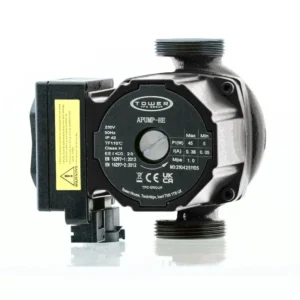
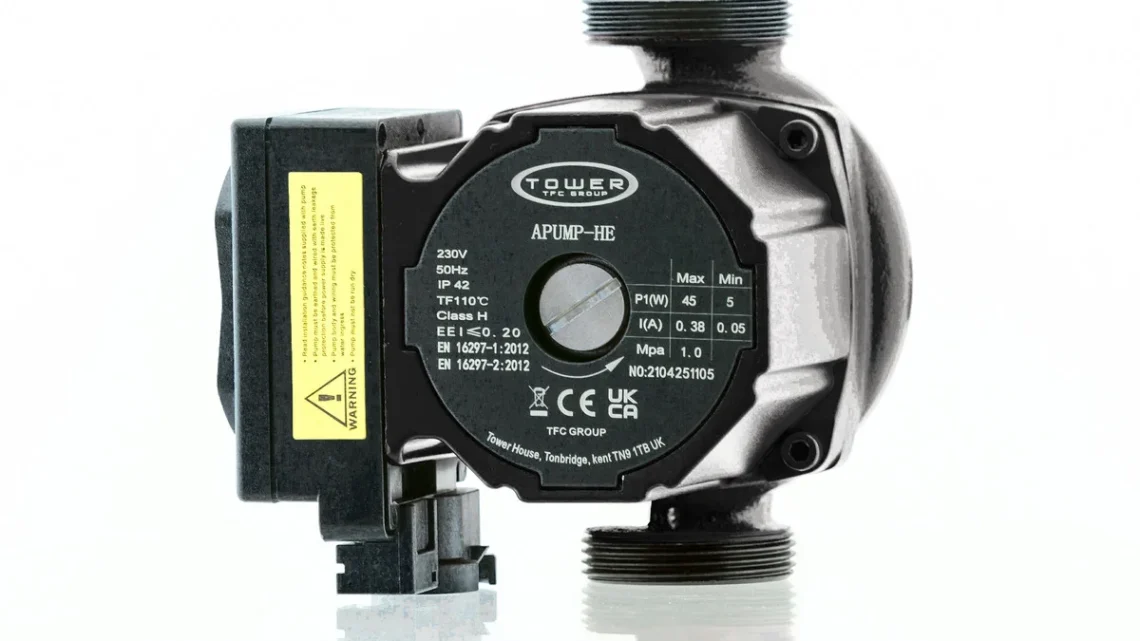
APUMPHE High‑Efficiency Circulator: a pragmatic look at suitability, limits and installation
July 28, 2026The APUMPHE is a modern permanent‑magnet circulator aimed at domestic central‑heating systems. On paper it delivers a low Energy Efficiency Index (EEI < 0.20), an automatic differential‑pressure mode and what appear to be modest running watts — all the ingredients expected from contemporary replacement pumps that want to cut energy use and noise. In this review I look beyond the headline claims to explain who should consider this pump, how it will behave in real systems, what installers need to check at the time of fitment and what owners can expect over the years.
Who this pump suits — and who should look elsewhere
The APUMPHE is primarily designed for single‑dwelling heating circuits where the demands are typical of domestic systems: a few radiators, a combi or system boiler and thermostatic radiator valves (TRVs) or zone valves that vary flow. The pump’s maximum head is 6 metres and its peak flow is 3.0 m³/h — figures commonly encountered in domestic primary circuits. Its modest physical size (approximately 130 × 130 × 128 mm) and 1.5″ G1 (BSP) flange with 130 mm port spacing make it suitable for many standard replacement situations.
Good candidates:
- Homes replacing older, inefficient wet‑rotor pumps and seeking lower running cost and quieter operation.
- Installations where the installer wants a pump that can auto‑modulate with radiator demand (TRVs, zone valves) to reduce electricity use.
- Compact plantrooms or cupboards where a noise level under 43 dB(A) is helpful.
Not a good match if:
- Your system requires higher head or flow than the stated 6 m / 3.0 m³/h — for example larger multi‑storey or commercial systems.
- Your existing plumbing uses a non‑standard centre‑to‑centre spacing or different flange format that can’t be adapted to 1.5″ G1 BSP and 130 mm spacing without significant modification.
- You need a pump with integrated complex controls, external communications (Modbus, OpenTherm etc.) or bespoke zoning intelligence — the APUMPHE provides Auto differential‑pressure control or fixed speed selection, but not advanced networked control.
How it behaves in everyday use
The APUMPHE uses a permanent‑magnet motor and internal differential‑pressure control. In plain terms this means the unit automatically adjusts motor speed to maintain a set relationship between flow and pressure when left in its Auto mode. For a typical house that translates to lower electrical draw at light demand — perhaps only a few watts — and higher draw as more radiators or zones call for heat.
Two practical consequences:
- Lower running cost compared with older fixed‑speed or three‑speed pumps because the motor spends most of its time at part‑load where permanent‑magnet motors are more efficient.
- Quieter operation during low demand because the pump spins slower. The manufacturer lists a noise level below 43 dB(A), which is in the range expected for pumps installed near living spaces or in cupboards.
There’s also a manual option: installers can lock the pump to a fixed speed between the device’s minimum and maximum settings. This is useful where predictable flow is preferred for commissioning or where a system has been sized around a specific pump curve. Bear in mind, locking to a high fixed speed will negate much of the energy‑saving potential.
Installation and compatibility: practical checks for installers
The APUMPHE presents as a standard replacement-style circulator, but some straightforward checks will avoid common pitfalls:
- Confirm flange and spacing: the pump uses a 1.5″ G1 (BSP) threaded flange and a port‑to‑port spacing of 130 mm. Measure the existing pump or flange adaptors before purchase — small mismatches need adaptors or bracket changes and can add time or cost on site.
- Electrical connection: this is a mains device (220–240 V AC, 50 Hz). Wiring must be carried out by a competent person in line with local wiring regulations and any boiler manufacturer requirements. Check the correct protective device and isolation arrangements are in place at the heater or consumer unit.
- Flow direction and orientation: confirm the arrow on the pump body and install with the correct flow direction. The manufacturer’s leaflet contains orientation limits; consult that for vertical/horizontal mounting restrictions and the recommended position for service access.
- System preparation: as with any new pump, ensure the system is correctly filled, pressurised and ventilated. Air in the system or trapped air around the pump can cause noise and reduce performance. If your system requires corrosion inhibitors or specific treatment, fitters should carry out the appropriate flushing and dosing procedures.
- Commissioning setting: decide whether to leave the pump in Auto mode or select a fixed speed. If the installer chooses fixed speed for initial commissioning, record the setting for future reference and explain the consequences to the end user.
Finally, consult the supplied instruction leaflet and spec sheet for wiring diagrams, fault‑indicator behaviour and any orientation or mounting caveats. The product documentation is the authoritative source for small but important installation details.
Performance and the evidence in the specification
The declared performance figures give a clear idea of capability but also of limits. Maximum head is 6 m and maximum flow 3.0 m³/h — perfectly adequate for most single‑dwelling primary circuits but not for larger systems. The EEI < 0.20 indicates the unit complies with ERP efficiency requirements, which helps reduce electricity consumption compared with older pumps.
Power consumption is described as auto‑adjusting and documented in the product material as circa 5–45 W. The product literature and datasheet show a small discrepancy (some material shows 5–40 W) so it’s sensible to confirm the exact maximum figure from the supplier’s printed datasheet if your site‑power calculations need a precise value. For everyday owners this range means energy consumed by the pump is small relative to typical gas or electric heating loads, but it does matter for annual running cost projections — a permanently locked high speed will consume more electricity than an Auto‑modulating setting.
Noise is quoted as under 43 dB(A). In domestic contexts that should be unobtrusive in most plant cupboards and acceptable near living areas, although perception of noise also depends on mounting, pipework resonance and whether the pump is isolated from the structure.
Strengths — the practical benefits you’ll notice
- Energy efficiency: EEI < 0.20 and PM motor design reduce electrical use during the many periods when the system demand is low.
- Auto modulation: differential‑pressure control reduces unnecessary energy use and can improve comfort by matching flow to demand.
- Compact dimensions: the pump’s small footprint and standard flange make it straightforward to fit in many domestic replacement situations.
- Lower noise profile: a sub‑43 dB(A) rating is a meaningful advantage for pumps sited near living areas.
Compromises and limitations to accept
- Capacity ceiling: the 6 m head and 3.0 m³/h flow are not suitable for larger or more complex systems. Always check system requirements before ordering.
- Limited control scope: useful Auto and manual speeds are provided, but this pump does not replace the functionality of an advanced zone controller or networked pump where those features are required.
- Installation details matter: the 1.5″ BSP flange and 130 mm spacing are common but not universal. Failure to check this can lead to additional adapters or installer time on site.
- Data consistency: minor inconsistencies between product text and datasheet on peak power mean you should confirm the exact figure if it matters for electrical protection or energy estimates.
Value considerations and what to ask before buying
Value isn’t just the upfront cost; consider lifetime energy use, installer time, warranty and support. The APUMPHE claims low running watts and ERP compliance, so if you are replacing an older pump you should see reduced electrical consumption. Ask the seller or installer for the following before you commit:
- A copy of the exact technical datasheet and wiring diagram for the unit you will receive, to confirm power range and wiring requirements.
- Installation compatibility: confirmation from the fitter that the 1.5″ G1 BSP flange and 130 mm port spacing matches your existing pipework or that suitable adaptors are available.
- Warranty and support terms: domestic pumps can last many years; knowing the warranty period and how to access spare parts or service locally is important for longer‑term ownership.
- Commissioning choices: whether the installer will leave the pump in Auto mode or set a fixed speed, and what implication that has for annual energy use.
If price is a primary concern, get a quote that covers both the pump and expected installation time/parts — a cheap pump that needs adaptor work or extra labour can quickly become more expensive overall.
Maintenance and long‑term ownership
The APUMPHE uses a sealed canned motor design with a permanent‑magnet rotor; that design reduces some traditional service items because there is no external shaft seal in the same sense as older wet‑rotor pumps. Nonetheless, treat it as you would any sealed circulator:
- Keep the system correctly treated and inhibitor‑dosed where required. Corrosion and sludge are common causes of premature pump failure in central‑heating systems.
- Ensure correct system filling and deaeration at installation, and check for air ingress periodically if you notice unusual noise or poor circulation.
- Record pump settings and installation date so any warranty claim is straightforward.
- If the pump shows fault‑indicating behaviour, refer to the manufacturer leaflet or the supplier’s technical support rather than attempting invasive repairs yourself.
Access to spares and local service varies by supplier; ask your seller whether replacement units, seals (where applicable) or technical support are available locally. In many domestic contexts, replacement rather than repair is the practical route if an electronic circulator becomes unreliable.
Realistic ownership scenarios
Scenario 1 — straightforward replacement: you have an older single‑dwelling pump with the same port spacing and flange. A competent installer can swap the pump, commission it in Auto and you’ll likely see quieter running and reduced electrical use. The installer should confirm system filling and inhibitor treatment at the same visit.
Scenario 2 — non‑matching flange or spacing: the pump fits the system conceptually but the physical connection differs. This will add time and possibly adaptors or changes to the mounting bracket. Factor this into the installation quote and check whether the supplier can provide the necessary adaptors.
Scenario 3 — larger property or multi‑zone heating: the APUMPHE’s head and flow may be insufficient. In such cases choose a pump specified for the system curve or consult a heating engineer to calculate head losses and the appropriate pump curve. Using an undersized pump leads to poor circulation and comfort issues.
Conclusion — balanced recommendation
The APUMPHE is a credible option for many domestic central‑heating replacements. Its permanent‑magnet motor, low EEI and Auto differential‑pressure control match current expectations for low‑energy, quiet circulators. For typical houses and compact systems it will deliver the main practical benefits you want: lower electricity use, quieter running and straightforward installation where flange spacing matches.
Before you buy, however, confirm the physical flange and port spacing, clarify the peak power figure from the printed datasheet for your electrical calculations, and agree warranty and support arrangements with the seller or installer. If your property needs higher head/flow or advanced control integration, look instead for pumps specified for those requirements. When installed correctly and commissioned with an understanding of its limits, the APUMPHE is a solid, energy‑focused replacement pump for standard domestic systems.
Latest product offer
Ready to check APUMPHE High-Efficiency Pump?
Check the latest product page, price and offer details before buying.