

Description
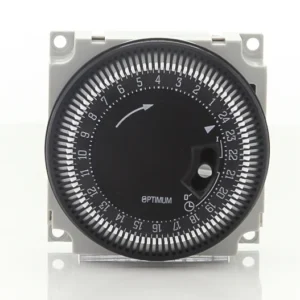
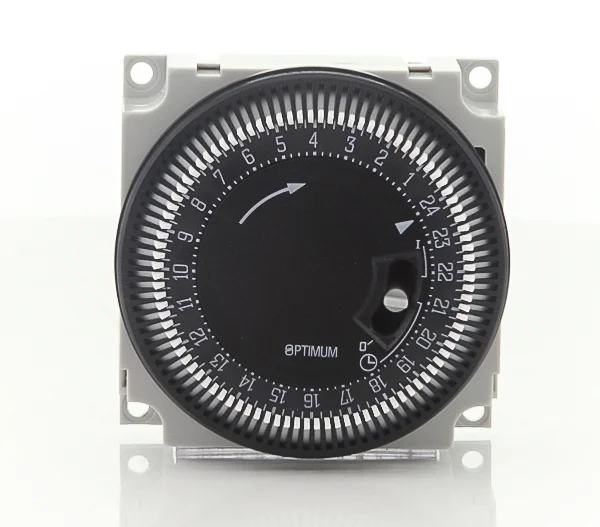
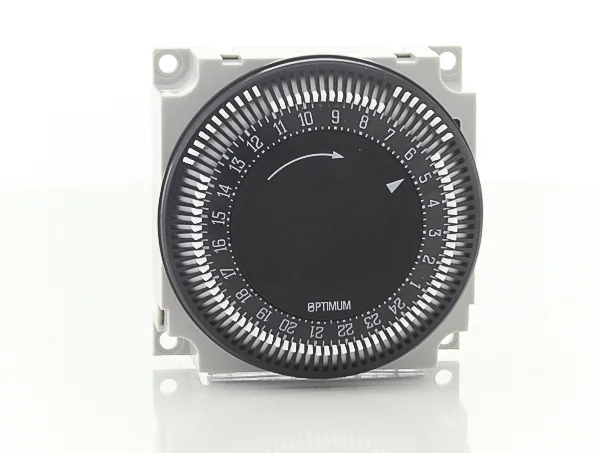
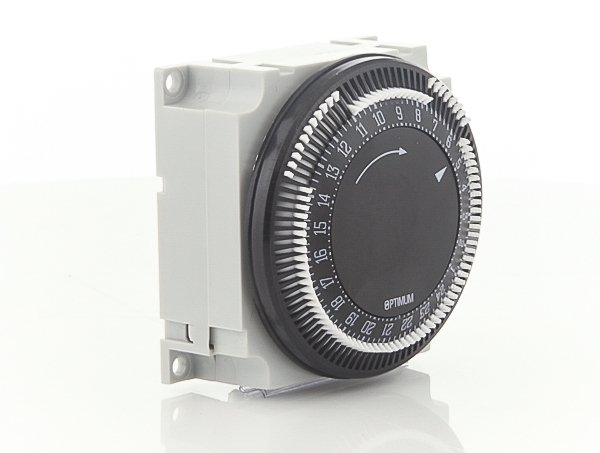
This is a compact, economy 24‑hour mechanical timer module designed to plug into the standard socket used on many wall‑hung boilers and control panels. The dial carries 96 captive tappets that move with a synchronous motor so you can set repeating on/off periods across the day with 15‑minute resolution. It performs a single volt‑free SPDT changeover function — the sort of simple daily scheduling most combi boilers and traditional lighting circuits expect.
Key specifications
- Supply: 220–240 V AC, 50 Hz
- Interval: 15‑minute tappet positions (96 per 24 hours)
- Contacts: volt‑free SPDT (changeover)
- Resistive rating: 16 A
- Inductive rating: 8 A (cos φ 0.6)
- Incandescent lamp load (informative): up to 1,300 W
- Minimum switched load: 100 mA @ 20 V AC/DC
- Power consumption (timer motor): ~1 VA @ 230 V
- Dimensions (approx): 60 × 60 × 32 mm; connections: 5 × 6.3 mm tab terminals
How it works and why you might choose it
The module is intentionally simple: an internal synchronous motor advances a 24‑hour dial once per day and the captive tappets control the internal changeover contacts. That fixed, repeatable behaviour makes it ideal where you only need a single daily programme — for example, switching a combi boiler’s built‑in programmer, a circulation pump or conventional incandescent lighting on a fixed schedule. Because it’s a plug‑in module built to a widely used footprint, it’s a quick spare or replacement for older boilers and sub‑panel installations where the original mechanical timer has failed.
Installation and compatibility
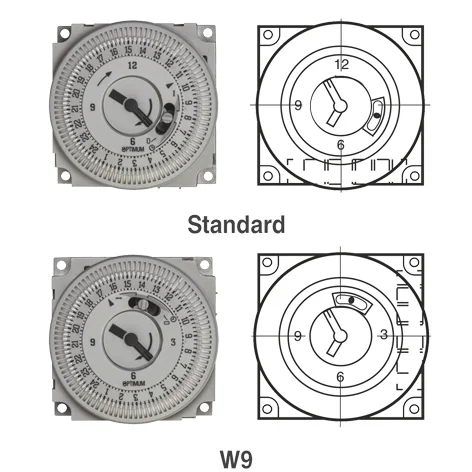
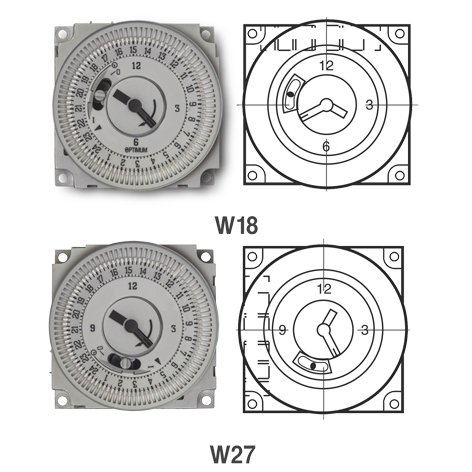
The unit is intended for sub‑panel mounting and plug‑in replacement use. It provides volt‑free SPDT contacts (so the timer itself does not supply mains to the controlled device) — that makes wiring straightforward but means you must check the boiler or control equipment accepts a volt‑free input. The module is rated for 16 A resistive switching and 8 A inductive (cos φ 0.6), so it can switch fairly large loads directly, although modern fluorescent/discharge or LED lamps may need a contactor or suitable driver rather than being switched directly through the timer.
There is no manual override on this particular variant, so it always follows the tappet programme; if you need temporary manual on/off or an ‘auto/off’ selector you should look for the related OP‑FM1STUH0 (the same family but with a front manual switch). Because the timer is mains‑synchronised, accuracy is good for mechanical modules and it will remain reasonably precise long term without adjustment.
Advantages and limitations
- Advantages: small, inexpensive and easy to swap into existing boiler sockets; robust electromechanical timing with simple 15‑minute resolution and a high resistive switching rating.
- Limitations: no manual override on this variant; not intended for direct switching of discharge/LED loads without a contactor; limited to a single repeating 24‑hour programme (no day‑by‑day differentiation).
For anyone replacing a failed mechanical programmer in a boiler or adding a simple daily timer to a panel, this OP‑FM1STU00 is a pragmatic, low‑cost option. It is not a modern smart controller and won’t give multiple programmes across the week or remote control — but for repeatable daily schedules and compatibility with older combi boilers it does the job without fuss.
If you need week‑by‑week variation, remote control, or to switch low‑current electronic lamps directly, plan for a different product or add a suitably rated contactor/relay. Also ensure a competent engineer checks the boiler’s control input and wiring before installation.