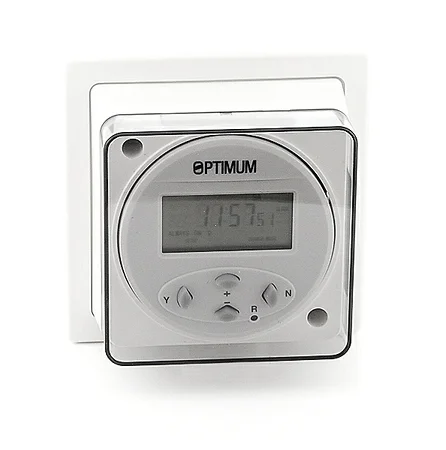


Description
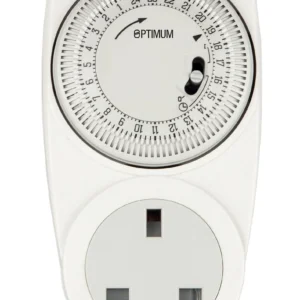
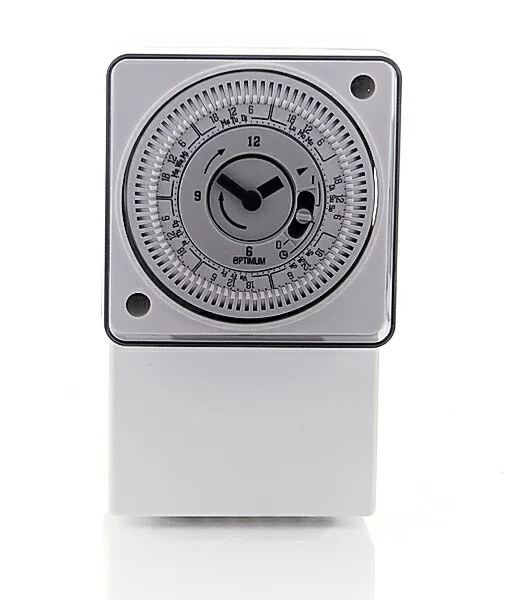
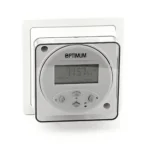
The OP-SBSDIGI is a compact, mains‑powered digital timeswitch designed to sit over a standard single pattress box and take routine on/off control tasks away from manual switching. It offers 24‑hour and 7‑day programming, up to 24 on/off events, a 1‑minute minimum interval and several convenient operating modes (including a built‑in random/occupancy function). In plain terms: it’s a straightforward programmable controller for domestic or light commercial loads where accurate scheduled switching and simple installation are wanted.
It’s aimed at applications such as electric heaters, pumps, simple motorised valves and other general resistive or light inductive loads. Because the output is a volt‑free changeover contact, it can also be used to drive a separate contactor for larger or specialised loads.
Key specifications
- Supply: 220–240 V AC, 50–60 Hz
- Switch type: volt‑free changeover (SPDT)
- Rating: 16 A resistive; 4 A inductive
- Programming: 24 On/Off programmes; 24‑hour and 7‑day options; day‑group selections
- Minimum switching interval: 1 minute
- Random mode: ±28 minutes variation around set times
- Manual override: Always On / Program On / Program Off / Always Off; plus Countdown and Random modes
- Running reserve: over 2 months at room temperature
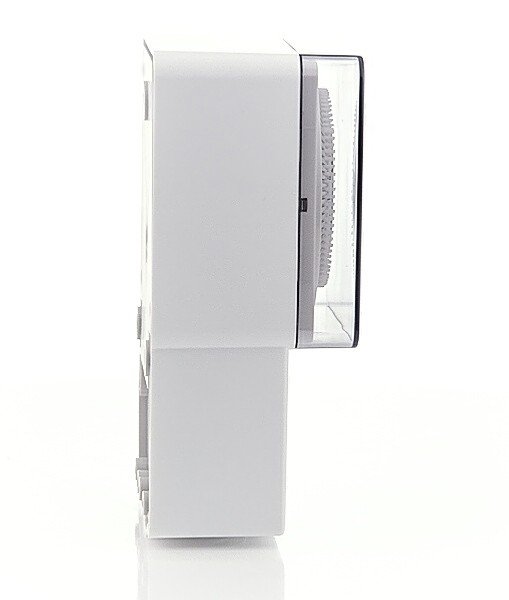
- Mounting: designed to fit a standard single pattress box; IP20; Class II control
How it works and how you’ll use it
Programming uses a small front‑panel LCD and a handful of buttons—Y to enter and confirm functions, +/– to change values and N to step through or exit—so basic setup is quick once you’ve set the clock and day. There are 24 individual ON/OFF pairs available, and the timer supports common day blocks (for example Monday–Friday, Saturday–Sunday) as well as individual days. That makes it flexible enough for most heating, anti‑freeze or timed‑lighting schedules where you want different behaviour on weekends.
The Random mode is deliberately conservative: when enabled it shifts each switching action randomly by up to 28 minutes either side of the programmed time. That’s useful for simulating occupancy if you’re using the switch to control lamps for security while away. A Countdown function provides a temporary timed override without disturbing the stored weekly programme.
Installation, wiring and compatibility
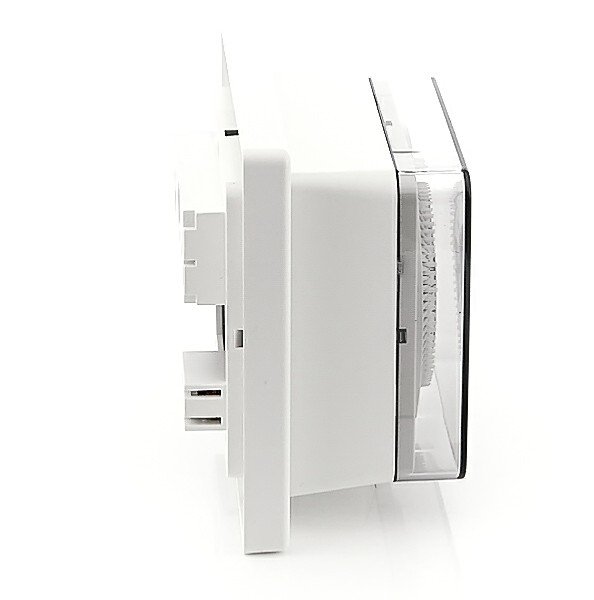
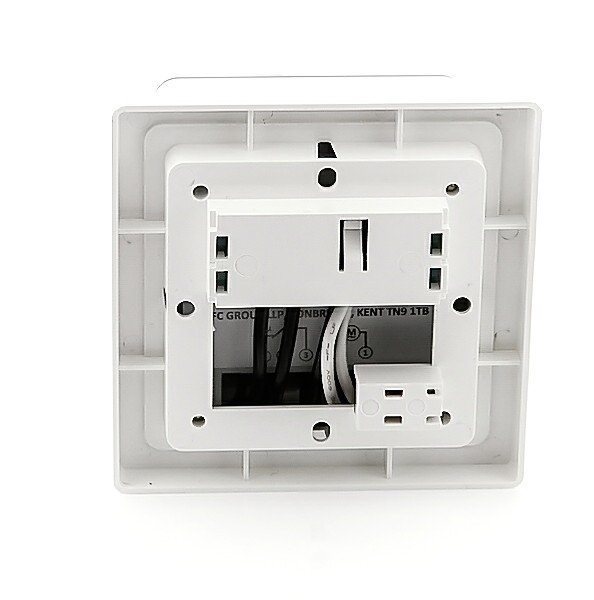
Physically the unit replaces a standard pattress‑mounted socket box module and needs a qualified electrician for fixed wiring. The backplate provides clear terminal labels and wiring diagrams for both live mains switching and volt‑free use. Installation instructions stress isolation of the supply (a disconnection device with at least 3 mm contact separation) and suitable routing of earth conductors when the switched appliance requires earthing.
Because the OP‑S BSDIGI switches with a volt‑free changeover contact, it can directly control resistive loads (heaters, immersion elements, towel rails) up to its rated current. For inductive loads (motors, some pumps) or any discharge/LED lighting, the manufacturer recommends using a suitably sized contactor or relay. The timer’s output is not designed for repeated direct switching of HID, SON or LED fittings without that extra relay—doing so will shorten life or may damage the timer.
Practical advantages and limitations
Advantages are clear: precise 1‑minute resolution (handy where you need tight control windows), a true 7‑day option for varied weekly schedules, and several manual override options so you can temporarily force or pause the programme without reprogramming. The running reserve preserves your settings for months if power is interrupted, which avoids the need to reconfigure after short outages.
Limitations are mostly about load and environment. The unit is rated for indoor use (IP20) and is a Class II control; it is not weatherproof and should not be mounted where it will be exposed to moisture. It’s intended for general‑purpose switching rather than heavy industrial duty: for anything above the stated rating, or for frequent switching of modern LED lighting and discharge lamps, fit a contactor between the timer and the load.
If you’re planning to control electric heating, towel rails or small pumps in a domestic or light commercial setting, this is a tidy, economical option. If you need Wi‑Fi, advanced energy monitoring or integrated smart‑home functions, those are outside its scope—look for a dedicated smart controller or a contactor‑based arrangement that the OP‑S BSDIGI can trigger.
Overall, this timer is best thought of as a reliable, low‑complexity timeswitch that gives more precision and flexibility than an analogue dial while remaining simple to install and operate.