Tower A3MID Mid‑Position Valve Actuator — practical appraisal for Y‑plan systems
July 27, 2026Mid‑position (3‑port) valve powerheads are one of those small parts that can stop a central‑heating system from behaving correctly: no hot water, no heating, or both coming on at once. The Tower A3MID is a straightforward replacement powerhead intended for mid‑position valve bodies such as Tower VAL322MP/VAL328MP and commonly used as a like‑for‑like swap for V4073A‑style heads. It’s compact, pre‑wired and equipped with the manual lever and auxiliary contact installers expect. This review unpicks what it will — and won’t — solve, explains installation and wiring practicalities, and covers the things to check before buying.
Who will find this suitable — and who should look elsewhere
The A3MID is aimed at householders, plumbers and heating engineers who need a direct replacement powerhead for a compatible mid‑position valve body. It suits several common scenarios:
- Replacing a failed or noisy powerhead where the valve body itself is in good condition.
- Keeping a van‑stock spare for routine call‑outs on domestic Y‑plan systems.
- Quick repairs where minimal pipework disturbance is preferred; the powerhead can usually be swapped without removing the valve body if you use the manual lever during the swap.
There are also clear cases where the A3MID is not the right option:
- If the valve body is leaking, corroded or mechanically worn — a new actuator will not cure leaks or damaged internals; the correct fix is a new valve body or a full valve exchange.
- If your installation uses a non‑standard shaft, mounting plate or bespoke wiring that differs from the industry convention for V4073A‑style heads — compatibility must be confirmed before purchase.
- Where the built‑in auxiliary switch would be used to directly drive high current loads — the switch is rated at 3 A resistive and is intended as a signal contact; heavier loads require an interposing relay or contactor.
Practical ownership and everyday use
In normal domestic Y‑plan operation the actuator positions the valve so boiler flow is routed to heating, to hot water, or partially to both. The A3MID provides synchronous motor drive and a spring return; the latter is a safety feature that returns the valve to a default position when power is removed. It’s a compact, lightweight unit (roughly 60 × 85 × 60 mm and around 0.48 kg) and draws only a few watts in service, so its ongoing energy cost is negligible.
The built‑in manual override lever is a useful everyday feature: it enables the engineer or homeowner to open or close the valve during filling, bleeding or commissioning without energising the control circuit. That makes the A3MID a practical choice for jobs where you expect to manoeuvre the valve manually while working on the system.
The auxiliary end switch provides a volt‑free changeover contact to signal when the actuator has reached its end position. In a typical setup this switch is used to tell the boiler and pump to run when the valve is in the correct position. Bear in mind the switch’s 3 A resistive rating — it is adequate for signalling but not for directly switching many modern boilers or pumps that require a higher switching capability or specific interlock behaviour.
Installation, wiring and what to expect on site
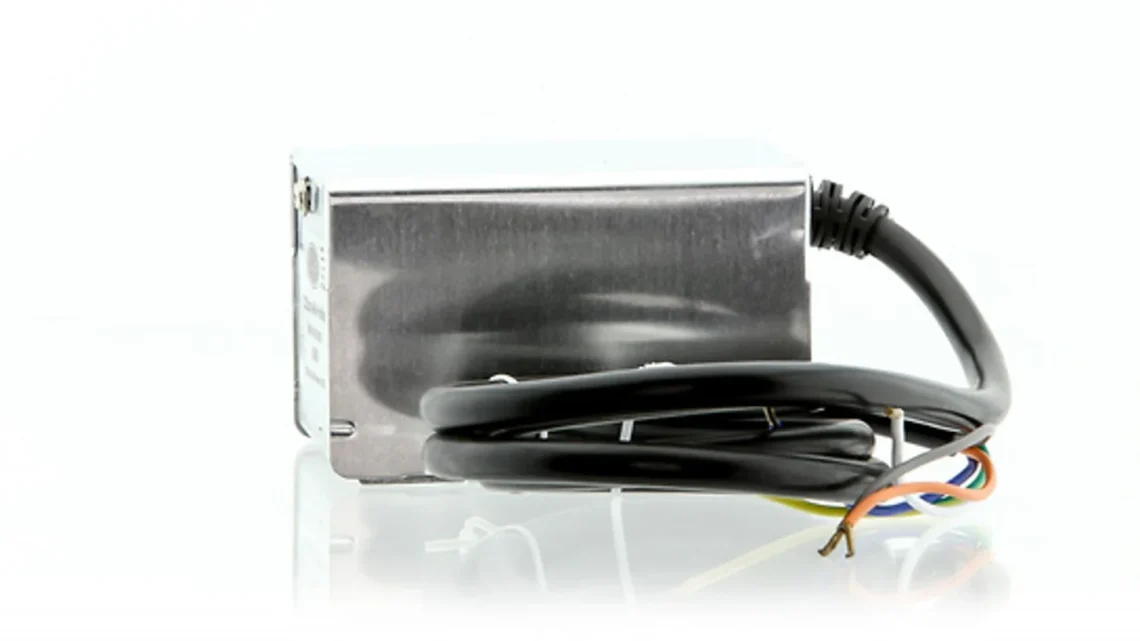
The unit is supplied with a 1‑metre, 5‑core flex using standard colours (white, grey, orange, blue and green/yellow). The manufacturer‑convention wiring maps to common Y‑plan arrangements and, in most like‑for‑like swaps, will match the cabling of an old V4073A‑style powerhead. That makes the A3MID convenient for quick replacements — you can often change only the head without removing the valve body, provided you put the actuator in the manual open position first and follow standard safety precautions.
Key wiring notes that you should observe on site:
- The blue conductor is neutral; the green/yellow is earth.
- White, grey and orange are used for control signals: typically room thermostat call, cylinder thermostat satisfied, and cylinder thermostat call/boiler drive respectively — check the convention used on your existing installation before making connections.
- All electrical work should comply with current UK wiring regulations and be carried out by a competent electrician or qualified heating engineer. Isolating the circuit before work is essential and the manufacturer references a 3 A fuse for the installation circuit.
Practical considerations during installation:
- One metre of factory cable is convenient for most swaps but may be short if the boiler or programmer is some distance from the valve — plan for safe routing and, if necessary, extend using appropriate cable and secure terminations.
- If your system uses an atypical control arrangement (for example multiple remote sensors or bespoke interlocks), review the wiring diagram and, where appropriate, use interposing relays rather than forcing the actuator switch to carry loads outside its rating.
- The actuator’s spring return function means it will move to its rest position when power is removed; be careful when isolating live circuits to avoid sudden system state changes that could cause noise, water flow where not desired, or unwanted boiler firing in some systems.
Compatibility and mechanical fit — checks to make before buying
The A3MID is designed to fit specific Tower mid‑position valve bodies (VAL322MP for 22 mm and VAL328MP for 28 mm) and is widely used as a replacement for Honeywell V4073A‑style actuators. However, compatibility is not automatic: valve housings vary in shaft profile, fixing arrangement and plate geometry, and some older or third‑party valve bodies use non‑standard interfaces.
Before ordering, check the existing valve or powerhead for markings and compare the shaft coupling and mounting plate. If you are replacing an actuator on site, confirm these points while the old head is still attached so you can avoid a wasted trip. If there is any doubt or the valve body looks corroded, seized or damaged, plan for the possibility of fitting a new valve body rather than just the head — that requires draining or isolating portions of the system and is a more involved job.
Performance expectations and technical limits
The A3MID uses a synchronous motor with spring return and consumes roughly 6 W in operation. For domestic Y‑plan systems this is more than adequate to move the internal mechanism of a properly functioning valve. The unit includes an auxiliary switch intended for signalling rather than direct load switching; its rated capacity of 3 A resistive must guide how it is used in a system design.
Environmental and pressure constraints are important because the actuator only replaces the head and does not alter the valve body’s hydraulic ratings. For example, the small valve bodies fitted in domestic systems have differential pressure and static pressure limits — the 22 mm variant often has a 1.0 bar differential limit and a quoted static pressure limit (manufacturer datasheets should be checked for the exact figures for your valve). If your system runs at higher pressures or unusual temperatures, verify the valve body’s suitability rather than assuming the actuator alone is the limiting factor.
Operational caveats to bear in mind:
- The auxiliary contact is suitable for low‑power signalling circuits only. Use a relay where a boiler or pump requires more robust switching.
- The 1‑metre cable can constrain installation in some setups; extensions are straightforward but must be made with correct cable type and terminations to preserve safety and compliance.
- The actuator is intended for fully pumped systems. If you have gravity circuits or non‑standard pump arrangements, confirm the system architecture with a qualified engineer before fitting.
Strengths, compromises and realistic trade‑offs
Strengths
- Practical, compact replacement: lightweight and easy to handle during a service call.
- Pre‑wired in standard colours and supplied with a manual override — useful for fast turnarounds during commissioning and bleeding.
- Spring return and an auxiliary switch give the control functionality expected in standard Y‑plan installations.
Compromises and limitations
- Auxiliary switch limited to 3 A resistive — not a substitute for a control relay where higher currents or inductive loads are present.
- One metre of cable is sometimes restrictive; practical installs may need an extension.
- Compatibility is limited to specific valve bodies — double‑check before ordering to avoid returns and wasted time on site.
Buying considerations and long‑term ownership
When deciding whether to buy an actuator like the A3MID, treat it as a targeted spare part rather than a universal fix. If the system’s symptoms point to a failed motor, seized stem or electrical fault within the existing head, replacing the powerhead is often the quickest and most cost‑effective remedy. Conversely, if the valve body shows signs of leakage, damage or wear, a head swap will be a temporary or ineffective repair.
Other practical buying points:
- Stock a single unit if you service multiple domestic Y‑plan systems — the pre‑wired, standard‑colour cable reduces time spent confirming connections during call‑outs.
- Plan for minor ancillary costs: an interposing relay if the auxiliary switch is to drive a larger load, longer cable where the fixed 1 m run is insufficient, and the possibility of valve body replacement if corrosion is discovered during the job.
- Check supplier support and returns policies before purchase so you can exchange the part promptly if it turns out the valve interface is non‑standard.
Maintenance, service life and support expectations
Actuators like the A3MID are low‑maintenance components. Typical care is limited to keeping the surrounding area reasonably clean and ensuring cable entry points remain intact. The spring return mechanism and the motor are sealed within the head; there are no user‑serviceable parts. In practice, failures that do occur are usually electrical (motor winding or switch) or mechanical (seized gear due to contamination), both of which generally require replacement of the head rather than repair on site.
For longer‑term ownership consider these points:
- Keep a record of valve body model numbers and actuator part codes for each installation — that makes future replacements quicker and avoids wrong‑part purchases.
- If your systems are in aggressive environments (e.g. dusty or corrosive plant rooms) inspect heads periodically as part of routine servicing because ingress or corrosion can affect long‑term reliability.
- Where the auxiliary switch is part of a safety or boiler interlock, ensure the overall control wiring and any interposing relays are included in maintenance checks, not just the actuator itself.
How to decide: replace the head or the whole valve?
Simple decision flow you can use on site:
- Visually inspect the valve body for leaks, corrosion or physical damage. If present, plan for valve body replacement.
- If the valve body looks sound, check the actuator wiring and power supply. If the head fails to move but the body is intact, replacing the head is the sensible first step.
- Verify the shaft coupling and mounting plate match the A3MID’s expected fit before ordering; if they don’t, choose the correct actuator or a valve replacement.
- Where the auxiliary contacts must switch more than 3 A or an inductive load, add an interposing relay rather than relying on the actuator’s switch.
Conclusion — who should buy the A3MID?
The Tower A3MID is a practical, no‑nonsense replacement actuator for domestic mid‑position valve bodies used in Y‑plan systems. It is best suited to straightforward head swaps where the valve body is sound and the control wiring follows the common V4073A/Tower convention. Its compact size, manual lever and pre‑wired cable make it convenient for routine servicing and engineers’ van stock.
It is not the right choice where the valve body itself is damaged, where the auxiliary contact would be asked to switch significant loads, or where the installation uses non‑standard valve interfaces. For those situations a full valve replacement or additional control hardware (relays, extended cabling) will be necessary. Consider the A3MID a good, pragmatic component-level fix for common Y‑plan faults — but check physical compatibility and the wider control requirements before you buy.
Latest product offer
Ready to check Mid-Position Valve Actuator?
Check the latest product page, price and offer details before buying.